
Daniele Mazzarella
Asymmetric Photocatalytic C-H Functionalization of Toluene and Derivatives
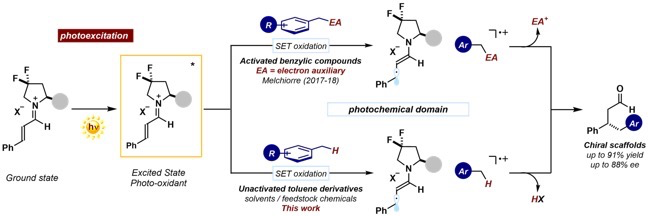
The emerging field of photoredox catalysis has led to the development of new transformations due to the ability to generate radical intermediates under mild conditions.1 Traditionally, this relies on a photocatalyst which efficiently absorbs light and induces a single electron transfer (SET). Recently, our group proved that a SET event can be triggered by the direct visible-light excitation of organocatalytic intermediates, unlocking reaction manifolds that are unavailable to conventional ground-state organocatalytic pathways.2 In particular, we demonstrated that photolytically generated excited-state chiral iminium ions act as strong SET oxidants, enabling the enantioselective β-functionalization of enals in combination with reaction partners bearing suitable electron-auxiliary functionalities.2c,d,e
To further expand the synthetic potential of this reactivity, we wondered whether this could be applied to the direct asymmetric C-H functionalization of simple toluene derivatives. This strategy is attractive as it utilizes highly available feedstock chemicals and visible-light for making chiral molecules. While the use of toluene has already been reported in photoredox processes,3 its employment in asymmetric catalysis has remained elusive.
This reactivity has been achieved by coupling the enhanced oxidizing capability of excited-state iminium ion with the basic character of its counter-anion to trigger a proton-coupled electron transfer pathway. This generates reactive benzylic radicals directly from the corresponding unfunctionalized precursors. The transformation proceeds under mild conditions and delivers the desired β-alkylated products generally in high yield and with good enantioselectivity.4
References
- H. Shaw, J. Twilton, D. W. C. MacMillan J. Org. Chem. 2016, 81, 6898.
- Selected contributions by Melchiorre and co-workers: a) Am. Chem. Soc. 2015, 137, 6120; b) Nat. Chem. 2017, 9, 868; c) Angew. Chem. Int. Ed.2017, 56, 4447; d) Angew. Chem. Int. Ed. 2018, 57, 1068; e) ACS Catal. 2018, 8, 1062.
- a) K. Ohkubo, K. Mizushima, R. Iwata, K. Souma, N. Suzuki, S. Fukuzumi Commun. 2010, 46, 601; b) R. Zhuo, H. Liu, H. Tao, X. Yu, J. Wu Chem. Sci. 2017, 8, 4654.
- Mazzarella, G. E. M. Crisenza, P. Melchiorre J. Am. Chem. Soc. 2018, 140, 8439.