
Matteo Lanzi
Italy
Synthesis of Carbolines via Palladium/Carboxylic Acid Joint Catalysis*
Carbolines are an important class of molecules due to their presence in many bioactive alkaloids and pharmaceuticals. Traditionally, Pictet-Spengler reactions represent the main synthetic strategy to obtain tetra-1H--hydrocarbolines (THC). Different metal catalysed approaches were recently reported, mainly based on gold catalysis, but these strategies suffer from tedious synthesis of substrates. We report an easy approach to THC derivatives from propargylic triptamines, which could in turn be obtained in one step. The methodology uses two distinct catalysts, namely a palladium (0) complex and benzoic acid. Both experiments and DFT modelling were performed to shed light on the mechanism of this sequence. The reaction proceeds via alkyne isomerization to the corresponding allenamide in the presence of a palladium hydride complex. Second insertion into the Pd-H bond is then followed by base-mediated indole C-H activation leading to the desired product upon reductive elimination. The reaction occurs with perfect chemo- and site selectivities, various alkyl, aryl, donating and withdrawing groups are overall well tolerated both in the propargylic position and on the indole fragment. This is the first sequential isomerization/C-H activation applied to tetra-1H--hydrocarbolines synthesis starting from readily available reagents.
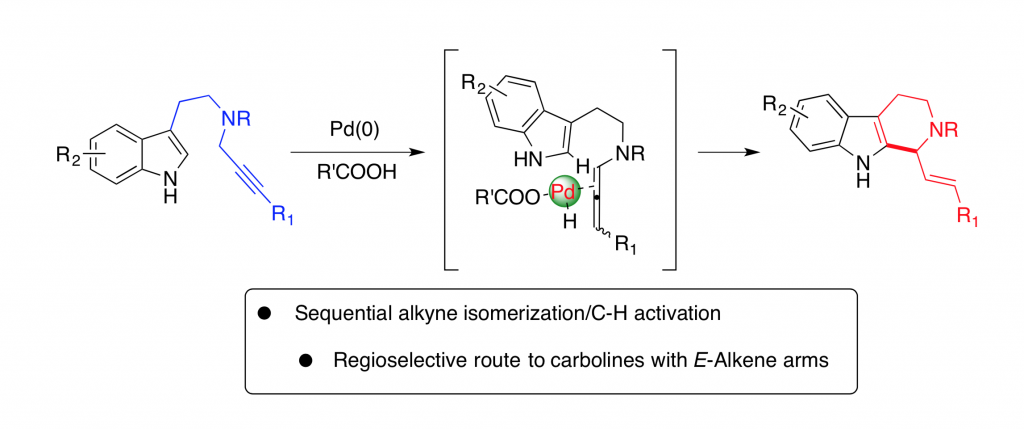
*Gianpiero Cera, Matteo Lanzi, Davide Balestri, Nicola Della Ca’, Raimondo Maggi, Franca Bigi, Max Malacria and Giovanni Maestri; Org. Lett., 2018, 20 (11), 3220–3224; DOI: 10.1021/acs.orglett.8b01072