CHIRAL CYCLOOCTADIENE LIGANDS IN C-H FUNCTIONALIZATION
Charlie Lim
Institute of Applied Synthetic Chemistry, TUWIEN
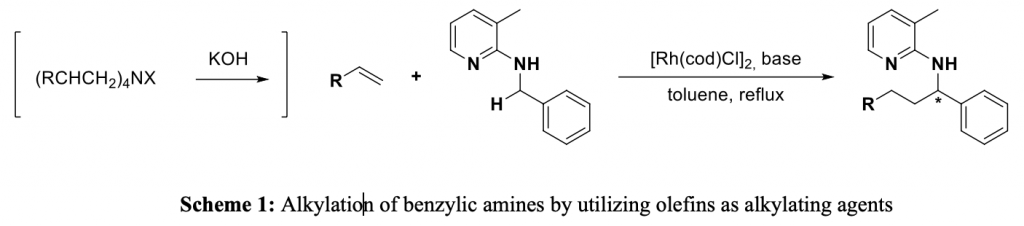
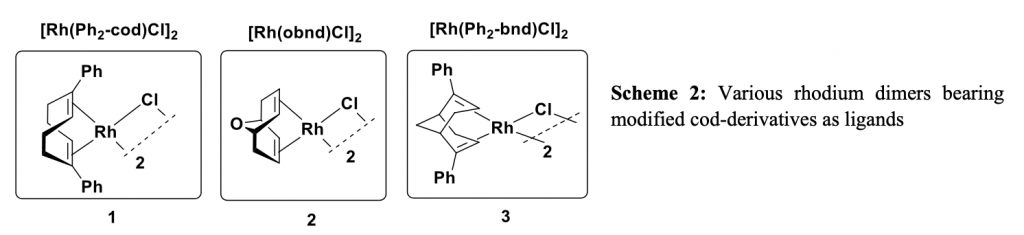
With improved control in site-selective C-H functionalization, the focus has shifted towards gaining control over enantioselectivity. Our group has previously reported the direct alkylation of benzylic amines via C-H functionalization by utilizing olefins as alkylating agents (Scheme 1).[1] Within this project, we are investigating the stereochemical induction by use of various cyclooctadiene-derivatives as ligands (Scheme 2). [2]
The catalyst 1, bearing a 1,5-diphenyl-substituted cod-ligand, showed no enantiomeric excess due to possible racemization via ligand dissociation and re-coordination on the other face. To elucidate the proposed racemization, we are currently investigating catalysts 2 and 3 that have bridge-moieties incorporated in their backbones. These bridge-moieties could potentially inhibit re-coordination of the free ligand on the other face and thus prevent racemization.
[1] M. Spettel, R. Pollice, M. Schnurch, Org Lett 2017, 19, 4287-4290.
[2] (a) A. Kina, K. Ueyama, T. Hayashi, Org Lett 2005, 7, 5889-5892; (b) Y. Otomaru, N. Tokunaga, R. Shintani, T. Hayashi, Org Lett 2005, 7, 307-310; (c) A. Takahashi, M. Aso, M. Tanaka, H. Suemune, Tetrahedron 2000, 56, 1999-2006.