Chemoselective Supported Ionic-Liquid-Phase (SILP) Aldehyde Hydrogenation Catalyzed by an Fe(II) PNP Pincer Complex
Julian Brünig
Institute of Applied Synthetic Chemistry, TUWien
The catalytic reduction of polar multiple bonds via molecular hydrogen is an important transformation in modern synthetic organic chemistry. Our group recently developed a highly efficient and selective [Fe(PNPMe–iPr)(CO)(H)(Br)] catalyst for the homogeneous reduction of aldehydes.1 In order to eliminate the major drawbacks of homogeneous catalysis, i.e., the need for separation and recovery of the catalysts at the end of the process, supported ionic-liquid-phase (SILP) catalysts can be applied. In a SILP system a homogeneous catalyst is dissolved in an ionic liquid and impregnated on a porous support material, thus the chemical nature of the homogeneous catalyst can be preserved.
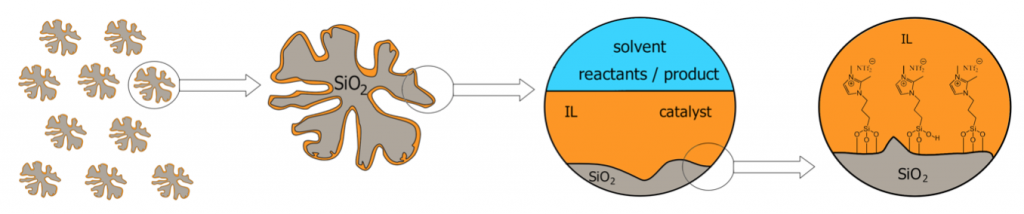
Figure 1. Example of a scheme for the shape of a SILP catalyst
For that purpose three different base-tolerant SILP systems with mesoporous silica as support material containing the well-defined hydride Fe(II) PNP pincer complex have been prepared, structurally characterized and used as catalysts in the chemoselective hydrogenation of aldehydes to alcohols under mild conditions (25 °C, 10-50 bar H2 pressure). The SILP systems showed high TONs and TOFs of up to 1000 and 4000 h-1 at the optimum pore filling degree. They were successfully used in recharge experiments to simulate a continuous flow system.2
Acknowledgements
The authors thank the Austrian Science Fund (FWF) for Financial support.
References
- Gorgas, N.; Stöger, B.; Veiros, L. F.; Kirchner, K. ACS Catal., 2016, 6, 2664.
- Brünig, J.; Csendes, Z.; Weber, S.; Gorgas, N.; Bittner, R. W.; Limbeck, A.; Bica, K.; Hoffmann, H; Kirchner, K. ACS Catal., 2018, 8, 1048.