
New Pyrimidine-based PCP Pincer Complexes of Non-Precious Metals
Gerald Tomsu
Institute of Applied Synthetic Chemistry, TUWien
The combination of activity, stability and variability make pincer ligands interesting for many different areas of chemistry including catalysis. A series of pyrimidine-based PCP ligand systems have been successfully introduced for non-precious transition metal complexes. A big advantage of this type of ligands is their modular design by changing the phosphine moiety, the amine linker and the ligand backbone.
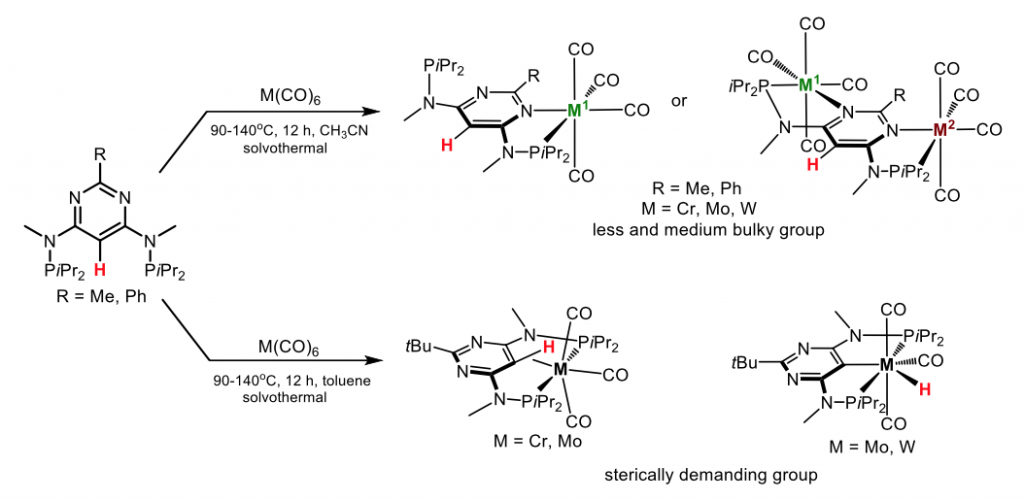
Figure 1. PCP-Pyrimidine Complexes
In this study we report the synthesis of a new series of PCP pincer ligands and complexes based on 2,6-diaminopyrimidine scaffold. The ligands can easily synthesized on a large scale. M(CO)6 (M = Mo, Co, W) was used as metal precursor for the complexation of the new PCP pincer ligands. The goal was to investigate the influence of the para substituent of the pyrimidine moiety on the complexation properties of the PCP ligands. PCP ligands with sterically little demanding substituents coordinate in k2-P,N fashion, act even as bridging ligand, while bulky groups at the PCP ligand enforce coordination in the typical k3-P,C,P mode or in a more unusual k3-P,CH,P fashion with an agostic C-H bond.
References
1 Murugesan, S.; Kirchner, K.; Dalton Trans., 2016, 45, 416.
2 Murugesan, S.; Stöger, B.; Carvalho, M. D.; Ferreira, L. P.; Pittenauer, E.; Allmaier, G.; Veiros, L. F.; Kirchner, K., Organometallics, 2014, 33, 6132.
3 Mastalir, M.; de Aguiar, S. R. M. M.; Glatz, M.; Stöger B.; Kirchner, K. Organometallics, 2016, 35, 229.