
NHC-coordinated Ni-, Co- and Ru-based complexes: Application in electrocatalytic C-C and C-heteroatom bond forming reactions
Stamatopoulos Chalkidis
National and Kapodistrian University of Athens, Greece
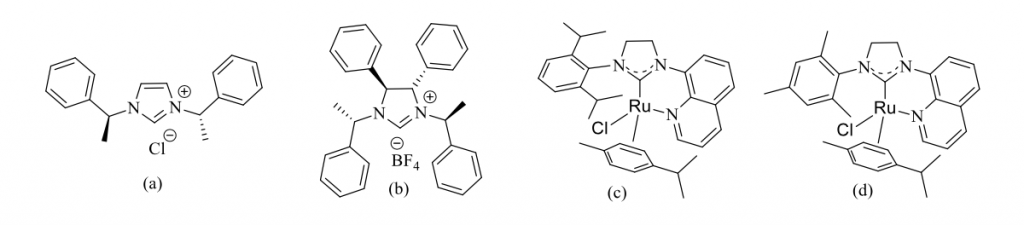
The interesting and tunable properties of N-Heterocyclic carbenes (NHCs) and related ligands have rapidly made them an interesting family of compounds in many areas of chemical research.1-3 In this work, the NHCs employed have a variety of tailor-designed steric and electronic properties, while some contain chiral centers. These NHCs are currently being studied as ligands in the synthesis of novel cobalt-, nickel- and ruthenium-based complexes. These complexes will be investigated with electrochemical and spectroelectrochemical methods, in order to shed light on their electronic structure in their various redox forms.4-5 Moreover, the activity of these complexes will be tested in (electro)catalytic C-C and C-heteroatom bond formation reactions. The results from the physical measurements and catalysis studies will be correlated to deduce sound structure-activity correlations in catalysis.
References:
1. Tzouras, N. V.; Stamatopoulos, I. K.; Papastavrou, A. T.; Liori, A.; Vougioukalakis, G. C. Coord. Chem. Rev. 2017, 343, 25-138.
2. Pinaka, A.; Vougioukalakis, G. C. Coord. Chem. Rev. 2015, 288, 69-97.
3. Vougioukalakis, G. C.; Grubbs, R. H. Chem. Rev. 2010, 110, 1746-1787.
4. Rechkemmer, Υ.; Breitgoff, F. D.; van der Meer, M.; Atanasov, M.; Hakl, M.; Orlita, M.; Neugebauer, P.; Neese, F.; Sarkar, B. Nat. Commun. 2016, 7, 10467.
5. Sinha, W.; Sommer, M. G.; Deibel, N.; Ehret, F.; Bauer, M.; Sarkar, B.; Kar, S. Angew. Chem. Int. Ed. 2015, 54, 13769.