
CpxRh(III)-CATALYZED ENANTIOSLECTIVE CYCLOPROPANATION VIA ALKENYL C-H ACTIVATION
Coralie Duchemin
Laboratory of Asymmetric Catalysis and Synthesis, EPF Lausanne, Switzerland
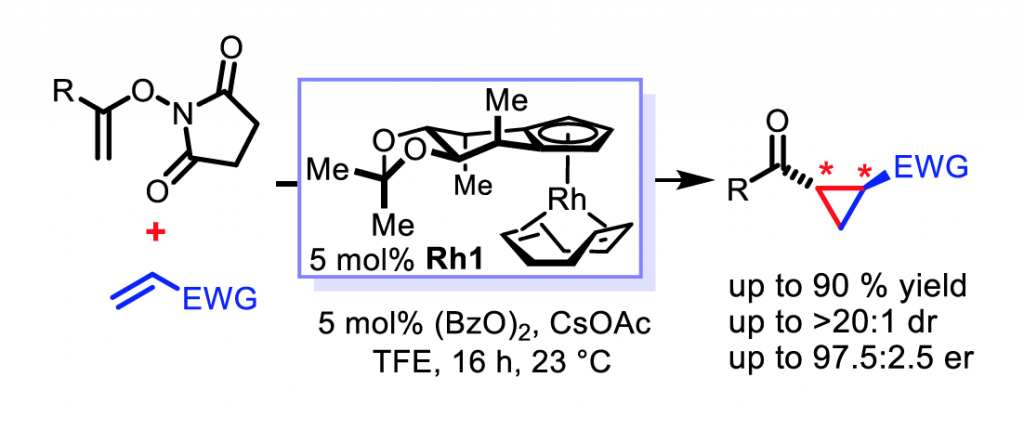
Optically active cyclopropanes are prevalent in many biologically active compounds and natural products. Several methods, such as the Simmons–Smith reaction, Michael addition-initiated ring-closure reactions, and cyclopropanations of olefins with metallocarbenes have been developed in asymmetric manners. Rovis and coworkers reported a rhodium(III)-catalyzed trans-cyclopropanation via alkenyl C-H activation.(1) Our group pioneered the development of highly efficient chiral Cp ligands for transition metal catalysis.(2) Their potential was demonstrated in combination with various metals for a variety of transformations.(3) Herein, we report the application of chiral cyclopentadienyl complexes to enantioselective alkenyl C-H activation leading to the formation of trans-cyclopropanes via a formal [2+1] annulation in good yields and excellent diastereoselectivities and enantioselectivities. Moreover, the synthetic utility of the developed method is demonstrated by concise syntheses of members of the oxylipin natural products and KMO inhibitor UPF-648.[4]
References:
[1] T. Piou, T. Rovis J. Am. Chem. Soc. 2014, 136, 11292.
[2] Ye, B.; Cramer, N. Science 2012, 338, 504.
[3] C. G. Newton, D. Kossler, N. Cramer, J. Am. Chem. Soc. 2016, 138, 3935.
[4] (a) C. Duchemin, N. Cramer, Org. Chem. Front. 2019, 6, 209-212; (b) C. Duchemin, N. Cramer, Chem. Sci., 2019,10, 2773-2777.