
Iron(II) Bis(acetylide) Complexes as Key Intermediates in the Hydrofunctionalization of Terminal Alkynes: Mechanistic Insight and Origin of Selectivity
Nikolaus Gorgas
Vienna University of Technology, Vienna, Austria.
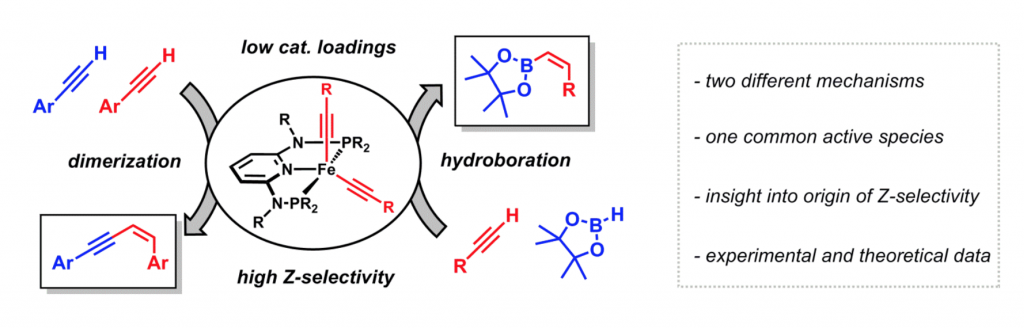
Our group recently described the synthesis and characterization of non-classical iron(II) polyhydride complexes supported by PNP-pincer ligands. These complexes were found to be catalytically active for the hydroboration or head-to-head dimerization of terminal alkynes exhibiting excellent Z-selectivity, even at low catalyst loadings and mild reaction conditions.[1] Now, we are providing detailed mechanistic insight into these types of transformations including activation of the pre-catalyst and origin of the Z-selectivity.[2] In particular, an iron(II) bis(acetylide) intermediate could be identified as common key intermediate in both cases, which, however, proceed via two basically different reaction pathways. This species as well as intermediates relevant for the elucidation of selectivity could be trapped and were fully characterized including X-ray diffraction. The proposed mechanisms are further supported by detailed DFT-calculations leading to a consistent picture of the underlying reaction pathways and the stereoselective steps of these transformations.
References
- Gorgas, N.; Alves, L.; Stöger, B.; Martins, A.; Veiros, L.F.; Kirchner, K.; “Stable, Yet Highly Reactive Non-classical Polyhydride Iron Pincer Complexes – Z-Selective Dimerization and Hydroboration of Terminal Alkynes”, Journal of the American Chemical Society 2017, 139, 8130–8133.
- Gorgas, N.; Stöger, B.; Veiros, L. F.; Kirchner, K. Iron(II) Bis(acetylide) Complexes as Key Intermediates in the Catalytic Hydrofunctionalization of Terminal Alkynes. ACS Catal. 2018, 8 (9), 7973–7982.