

Copper-Catalyzed N-F Bond Activation toward Intramolecular C-H Amination Reactions
Pedro J. Pérez
The Barcelona Institute of Science and Technology, Tarragona, Spain
Radical-based transition metal-catalyzed reactions have become an essential tool for the construction of carbon-carbon and carbon-heteroatom bonds in organic synthesis. Some of the advantages of radical processes are the use of mild and neutral reaction conditions, functional group tolerance, and the capability of inducing cascade reactions that increase the molecular complexity. Consequently, radical reactions have attracted considerable attention in the synthesis of many natural products during the past decades.[1]
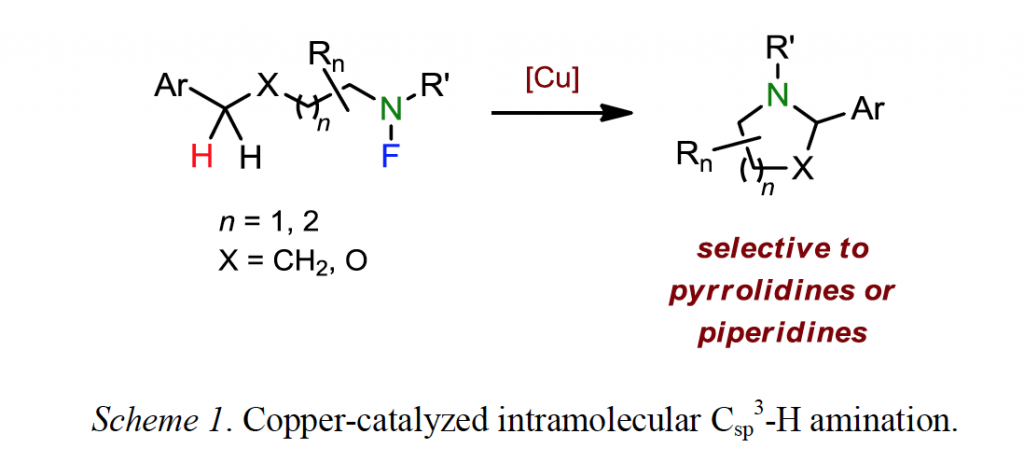
In the framework of this COST CHAOS Action, we present the results derived from a collaboration of three groups in which N-F bond acts as an effective nitrogen source and oxidant in intramolecular C-H functionalization. Copper catalyst exerts full chemoselectivity control in a new transformation, which leads to series of nitrogenated heterocycles with predictable ring size. DFT studies have led to a mechanistic proposal for such transformation.
References
[1] R. Ardkhean, D. F. J. Caputo, S. M. Morrow, H. Shi, Y. Xiong, E. A. Anderson, Chem. Soc. Rev. 2016, 45, 1557-1569.