
Synthetic approaches towards different azaindolo[3,2,1-jk]carbazoles
Thomas Kader
Institute of Applied Synthetic Chemistry, TUWien, Austria
Arylamines are widely applied as electron donor building blocks in organic materials for OLED applications. Our investigations on planarization of triarylamines revealed that increasing planarization leads to a decrease of donor strength (figure 1, left). Additionally, both theoretical calculations and experimental data indicated also weak acceptor character of fully planarized indolo[3,2,1-jk]carbazole (ICz).[1]
Based on these findings, our current research focuses on further modification of the ICz scaffold by incorporation of electron withdrawing pyridine like nitrogen atoms to further increase the acceptor strength. We developed a comprehensive synthetic approach based on palladium catalyzed C-H activation for the synthesis of all six possible mono and six different twofold nitrogen incorporated NICz isomers.[2] Characterization of the new building blocks revealed that their electrochemical and photophysical properties not only depend on the amount of nitrogen incorporated but in particular on the nitrogen position within the scaffold. Therefore, the control of the nitrogen position allows to fine tune the molecular properties. Beside the alteration of electrochemical and photophysical properties, the nitrogen position impacts intermolecular interactions and therefore influences the alignment in the solid state.[2,3]
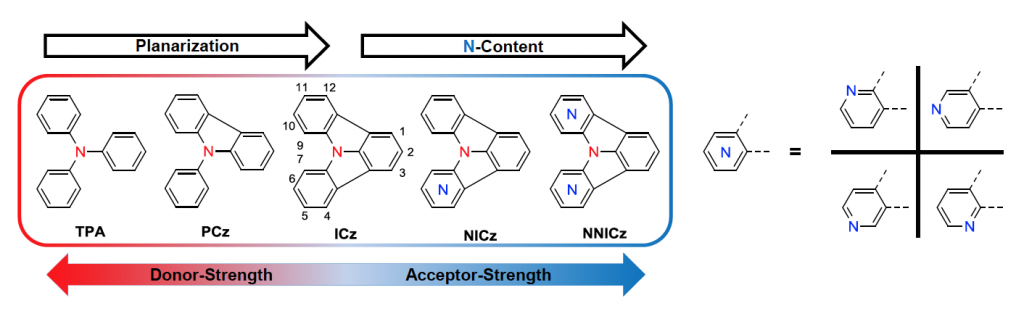
Figure 1: Concept of donor- and acceptor-strength control by planarization and nitrogen incorporation [2]